Etchings of the Eons with Andrea Koroveshi
Art is an enormous part of Stonesaga, woven into the mechanics. While the earliest art for the game might be my doodly explorations of giant cave worms and supernatural rocks, we obviously knew we’d be hiring a professional artist for the game, and Brendan found a fantastic one in Andrea Koroveshi. Andrea really brought Stonesaga’s locations, creatures, characters, and behemoths to life, and today we’re talking to him about his process!
Max: How did you come up with these amazing designs for the behemoths? Tell us about your process.
Andrea: From the very beginning, we aimed for something huge. The idea was for these behemoths to feel almost like living monuments that evoke awe, like parts of nature that have risen and begun to walk.
From there, we gradually introduced elemental aspects: rock, ice, fire, plant, and water. However, once I began sketching the early concepts (starting with the rock behemoth and then the vine behemoth) I realized that giving them animal-like faces wouldn't work. Familiar facial structures are immediately recognizable to the human eye, and their proportions felt off at such a massive scale. This realization led to a unifying design principle: all the behemoths would have ambiguous, almost abstract faces.
The ice behemoth, in particular, features a tribal-like pattern across its face, reminiscent of cave wall paintings. Another crucial element of the design is the environment surrounding each behemoth. The background provides a sense of their immense scale while offering a glimpse into the worlds they inhabit.
Max: That’s really cool! I didn’t know about the way you conceived of their faces. It does really help to unify them visually!
Speaking of the recurring motifs of the game, Early on, we discussed integrating the omens (the moon, the clouds, the comet, the stars, and the sun) into the art of a lot of different game components. What was your process for coming up with different visual depictions of these omens?
Andrea: As with all the art in the game, the main inspiration was Stone Age cave art. With that in mind, I strongly believed that the omens needed to feel like an inherent part of whatever they were integrated into. Even in a fantastical world, I deliberately avoided overly fantastical themes, instead striving to make the omens feel as natural and grounded as possible.
For example, a moon omen on a deer becomes a subtle pattern of color in its fur; a sun omen on water manifests as a ripple on the surface; a comet omen on a hex appears as a feature of the terrain itself.
While we could have represented these as clear graphical icons, Taryn (the art director) and I decided that this kind of natural integration was far more aligned with the game’s themes. It also makes discovery more rewarding for players—especially when they notice the subtler, harder-to-spot omens.
Max: Yeah, I’m really pleased with how the hidden omens came out. They reward that extra attention to detail. in a very cool way! Overall, we really wanted to inject a lot of mystery into the world of Stonesaga, and your art brought that to life so vividly. What are some ways you added a sense of grandeur and mystery to your depictions of the world of Stonesaga?
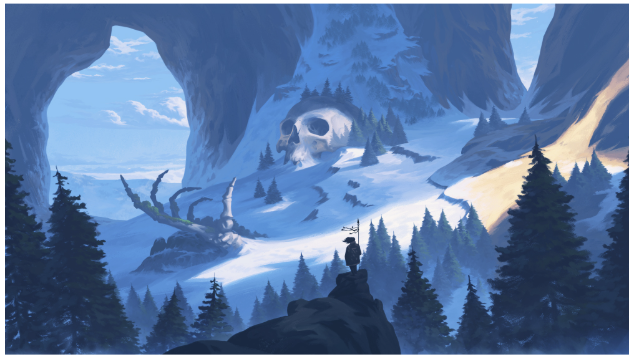
Andrea: Much of Stonesaga’s sense of mystery is built through the illustrations depicting members of the tribe stumbling upon something strange. You might be hunting in the forest when you reach the edge of a ravine overlooking the valley below. Pushing aside the branches, you discover a 300-meter-long human skeleton sprawled across the land. You stand in awe, knowing you will never receive a clear explanation of its origin, or of what happened to it.
There are many moments like this throughout the game, where questions are left unanswered. This ambiguity adds to the mystery and invites the player’s imagination to fill in the gaps. What the game chooses not to explain outright, you are free to interpret for yourself. I even found myself wondering what it would be like to reach that skeleton and see it up close.
In every illustration, I aimed to make nature feel harsh and overwhelming. Yet at the center of each scene, there are always humans ready to conquer it.
Max: Stonesaga definitely makes the most out of visual interpretation, especially in systems like foraging and crafting. What was it like working on the crafting materials and foraging cards?
Andrea: It was a lot of fun and a pleasant change of scale. Working at such a small scale was surprisingly rewarding, where painting a single bone or rock felt just as meaningful as creating full world-building illustrations. I remember reading each crafting material description and trying to come up with something visually interesting and unique, while still keeping it readable at the tiny scale they would be printed on. The legendary materials harvested from the behemoths were especially enjoyable to paint.
The same approach applied to the foraging cards. But they also offered an opportunity to show what the terrain depicted on the hexes actually looks like on the ground, from the perspective of the tribe members. There are many terrain features on the hexes and I am happy we got to depict a few of them as backgrounds on the foraging cards.
Together with the art director, we worked to ensure that the foraging cards functioned both mechanically and visually, supporting gameplay while reinforcing the world of Stonesaga.
Max: Is there anything else you want to share about your experience working on Stonesaga?
Andrea: Yes, it was an amazing experience. The team’s dedication to the game, and their love for the genre was the driving force that made me to push myself and grow as an artist over the years. For any artist trying to break into the industry and hoping for someone to take a chance on them, this project stands as a perfect example of what that trust can enable.
That is why Brendan’s decision to trust me with the art for a game of this scale meant so much to me. I will always cherish this experience as something I am deeply proud to have been part of, and I’m incredibly grateful for the opportunity.
Max: Thanks, Andrea! We couldn’t have done it without you! Now, on to the lightning round:
Which behemoth is your favorite?
Andrea: The vine behemoth, ice behemoth close second.
What are some of your favorite giant monsters from myth and fiction?
Andrea: As a child I liked the titans from Disney’s Hercules movie.
Which behemoth do you think would be the hardest to climb?
Andrea: The rocky behemoth since it’s the largest of all.
What was your favorite terrain hex to illustrate?
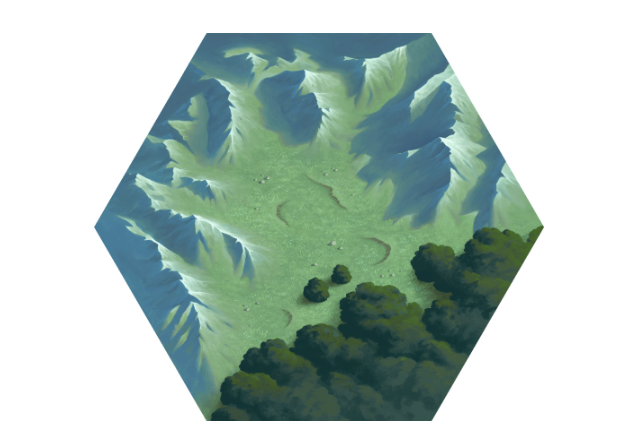
Andrea: It has to be this one. I love painting mountains and there’s something calming in this hex’s simplicity:
What is your favorite illustration in Stonesaga?
The cover art for the core box, the one with the giant skeleton.