Firelight Musings with Brendan McCaskell
Stonesaga began with a strong vision: a world of prehistoric fantasy and the inside of a game box transformed into a cave wall on which to draw. As soon as Brendan pitched me on this, I knew I had to make this game. Like a mining token in a bag, I couldn’t fully perceive the final shape of it, but I could feel the texture from just that initial concept and the ensuing discussion.
Of course, this initial spark doesn’t exactly sound like a game on its own. And that’s because it isn’t. But then again, neither is “fighting a duel between dimension-hopping wizards with cards,” “play-acting the adventures of mercenaries in a world of fantasy,” or “hopping into the cockpit of a giant robot for a building-smashing brawl.” Sometimes, the high concept is enough to send the imagination spinning wild.
Today, I want to go back to the start of this saga. I’ll be asking Brendan McCaskell (founder and CEO of Open Owl Studios) some questions about the genesis of Stonesaga, product design versus game design, and the murky imaginings from which the behemoth’s trod forth.
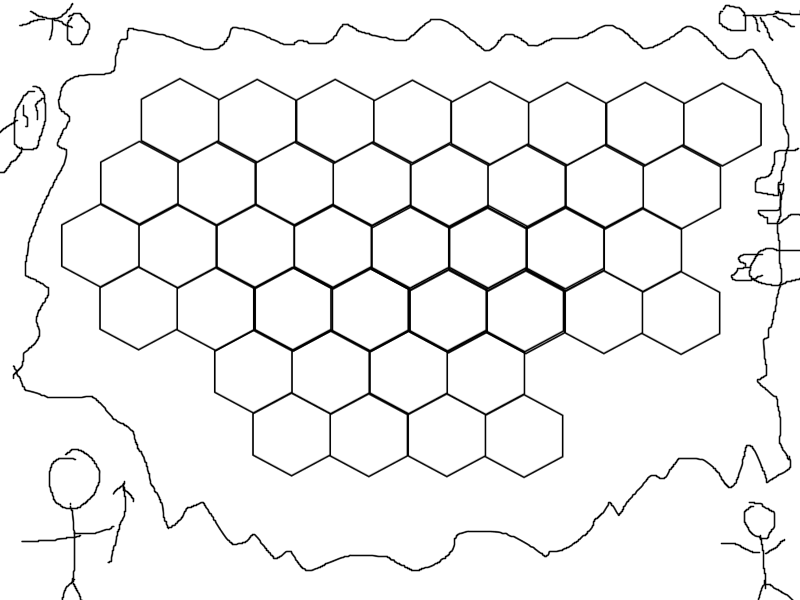
This was on my hard drive entitled “Max’s Amazing Neoprene Playmat Concept.” I have only the vaguest recollection of making it, but I feel it captures the energy of the early creative process well.
Max: So, take us back to ancient history. Where did the idea of Stonesaga come from?
Brendan: Like most good ideas, I believe it was a shower thought.
I love survival crafting games and I believe my wife and I were pretty deep in the weeds on Valheim at the time. So naturally I started to think through adapting some of the vibes of these types of games to the tabletop.
When I started to think about where a survival crafting game could be placed, I was immediately drawn to the prehistoric and their cave-wall paintings. I had a simple thought: what if the interior of the box lid was a blank cave wall and after each session you marked the cave wall with what you accomplished. Then, after dozens of sessions, you would go to open the box and see an entire history of a community!
This got me pretty excited and the rest is history ;).
Max: For reference, I found these notes from one of our earliest calls.
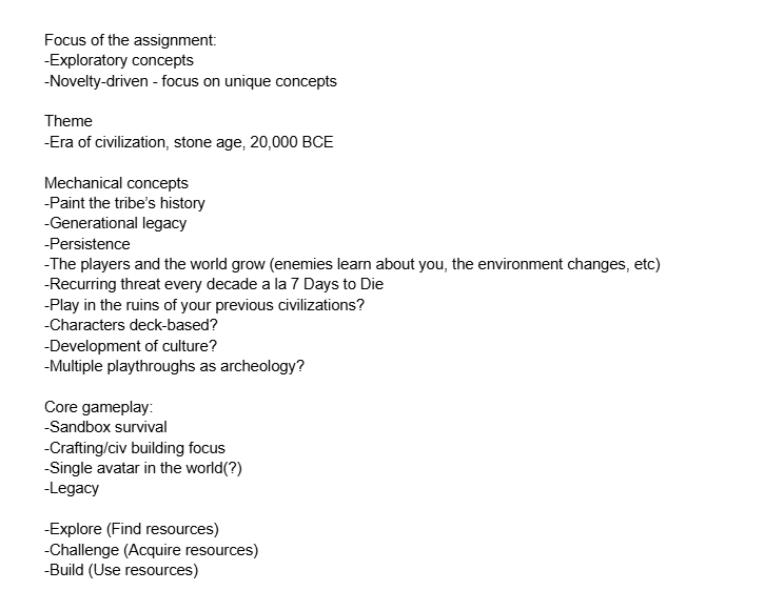
I seem to recall we settled pretty quickly on the idea of generational legacy, storytelling, and cyclicality as major themes (as I’ve discussed in the past). What drew you to those themes?
Brendan: We knew we wanted to tell epic stories that felt rooted. This is why Stonesaga is not a “Civilization” game. In Stonesaga, you control a single individual at pinnacle moments throughout history.
It has always reminded me of the storytelling of Isaac Asimov’s Foundation series. How do real humans respond in moments of generational crisis.
Psychohistory with rock monsters. I dig it.
I remember we also went back and forth on whether or not Stonesaga should be a legacy game, and came up with the idea of “persistent” gameplay rather than “legacy” gameplay. How do you think about the difference between those things?
Legacy is all about permanently altering components - often to the point where you can only play the game once (think Pandemic Legacy). And while there are components that you write on in Stonesaga, none of these make it so that you cannot experience the game more than once.
Persistence means that we can accomplish a lot of the same type of storytelling through our tray system and other save systems without needing you to destroy your copy of the game!
Speaking of persistent things, our relationship on this project has been, in my mind, a really good illustration of how product design and game design both overlap and differ. For instance, I remember in an early draft of the game, we had “nodes” within each hex for much more procedural mapmaking.
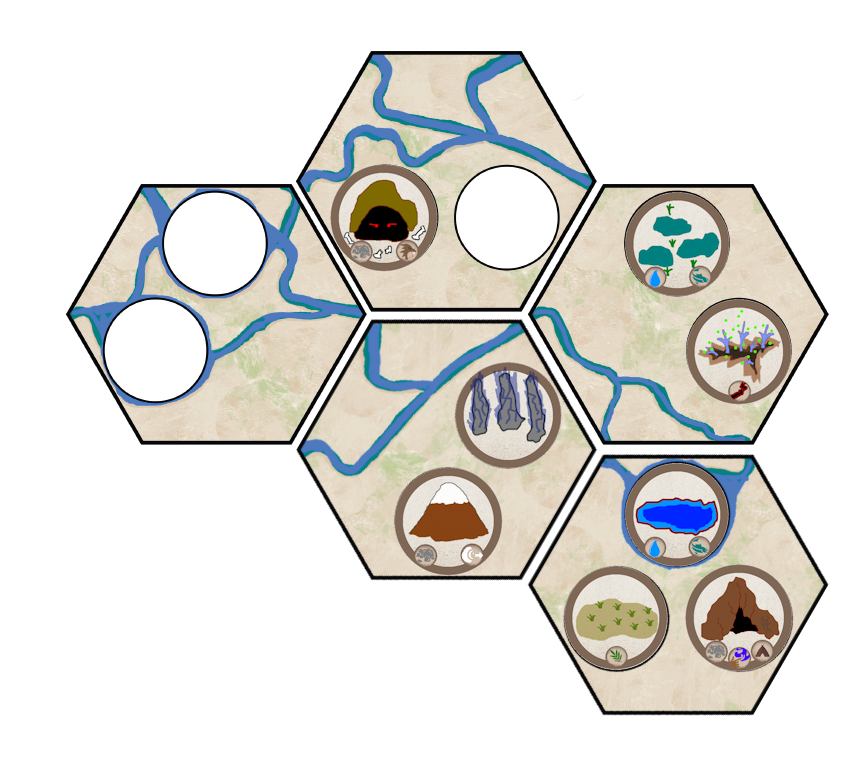
We tested that version, and I remember that what came out of the conversation afterward was that the nodes were an interesting game design element, but didn’t fit the product design because they restricted the visual presentation options too much. That was a really good point, and obviously we ended up going with much more visually evocative hexes (which, interestingly, further underscored the “art-as-mechanics” aspect of Stonesaga, which was a good choice for the game).
When you’re working with someone on design, how do you think about the difference between these sorts of “product design” calls and “game design” calls you’ve made when you’re also in the lead design role?
I think one of the most unique parts of Open Owl Studios is our commitment to holistic design - where we consider the product and game working together, instead of the product being an afterthought. For example, early on we did some research on how our terrain trays could work and save from session to session. This was fundamental to our game design choices later on.
If you are not thinking about the game in a wholistic sense, there are a lot of elements that just cannot happen because oftentimes designers get focused so much on specific mechanics without regard to the entire package!
What? I never fall into that trap. Nobody check the reams of notes on over-specific, non-workable ideas on my hard drive!
Speaking of product design, I remember we went through a bunch of iterations - Tribal Quest, Lithotaph, and finally Stonesaga. What makes a game title stick?
I’m a sucker for two words smashed together. I think Brandon Sanderson inspired me in that (look at any of his book titles and you will see what I am talking about).
It’s kind of fitting I ended up consulting on the Cosmere RPG in part because of some of our Sanderson-related conversations (and some blog posts I wrote on them!).
One aspect of Stonesaga that you took direct lead on was how the game sets up and tears down, and you did a lot to make sure it’s a really smooth experience. That wasn’t something I really had thought much about until I saw you doing it (I hope I didn’t make your job too hard in this regard, with all the tokens). What made you so interested in this aspect of games, and what have you learned as you’ve made this a key part of Mythwind, Stonesaga, and your other games?
A game that can be set up quickly will be played much more often. When I was talking to our tray designer about Mythwind, I did the math for him about the actual years we have saved people's time by focusing on this.
Also, personally I hate when setting up a game takes a ton of time. Just let me play!
Okay, speaking of getting to the good stuff, let’s do a lightning round!
Which of Stonesaga’s activities is your favorite?
Foraging has always been my go to!
Is there a mantle you always grab first when playing?
I don’t remember his name but the green guy - he’s my BGG avatar! [editor: the Mantle of the Wanderer]
Which animal companion would you want as a pet?
Doggo!
Favorite behemoth?
The first one - big rocky dude in the trees!