Breaking Points: Precipice’s Lessons from the Past (Dark Heresy Design)
In my previous blog post, I wrote about the way in which my experiences with Warhammer homebrew shaped the kernel of the idea that would become Precipice, before I even began my career in the games industry. I hard started to understand the game I wanted, but I didn’t yet have the skills to make it. So, how have my years working on RPGs and miniatures games inform my perspective on realizing the design I knew I wanted? As a quick refresher, those points were:
I wanted mechs to become damaged in ways that felt impactful on play, forcing players to adapt their strategies as a game unfolds.
I wanted to feel like I was controlling the mechs from the cockpit, not from a table in a command tent (holographic or otherwise).
I wanted the skill and status of the pilots to matter mechanically as characters.
Today, I’ll handle the first of those questions.
How to make damage interesting?
When I first read Dark Heresy (in college, well before I got a job working on Rogue Trader and later Only War), I was fascinated by its critical damage tables. After beginning my journey into RPGs with the rather more abstract damage rules of Dungeons & Dragons 4th Edition, I loved the idea of that the specifics of a hit mattered: where it landed, what damage type it represented, and even how deadly it was. Dark Heresy’s critical hit tables were deeply evocative and exciting to roll on, though the longer I played the game, the more I felt that they rarely created mechanical interest as printed. Some results did, but many results just incapacitated the character rather than changing their options in interesting ways. This was probably realistic (or at least one of the more realistic parts of a set of tables where wounded characters tended to spray Kurosawa-esque volumes of blood), but it wasn’t very interesting for the player.
When the team was told we’d be making Dark Heresy 2nd Edition, we knew that we had a chance to revisit this. And so when Andrew Fischer began designing the game, I asked to design the critical damage tables, and he agreed. In these redesigns, I focused on making different damage types feel meaningfully distinct while also making results that tended to removed options rather than incapacitating a character entirely. Of course, I also tried to maintain the gribbly, evocative prose that made me love the original incarnation of these tables.
Around the same era, I started thinking about how damage to the body of mecha in my favorite series worked within the narrative. The mecha genre often depicts war, and having a humanoid shape for the robots creates a unique opportunity to visually gesture at the brutality of war within a work rated for public broadcast. And what’s more, the mech breaking apart can serve as a visual reminder of the pilot’s growing distress, a physical externalization of anguish. The harder they push themself, the more the machine can mirror the toll of war upon them.
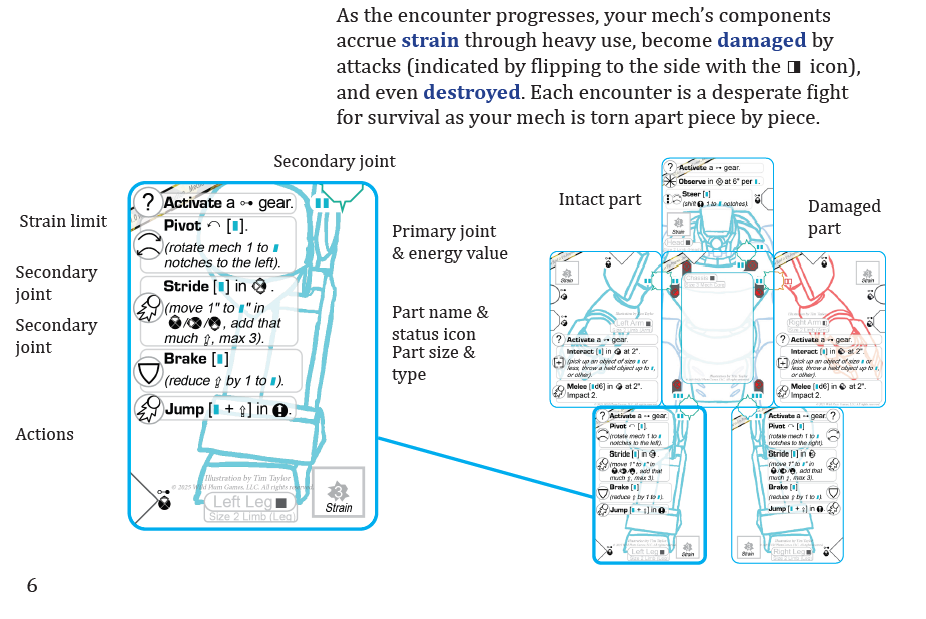
From Alpha Rules p. 6
Implementation: In Precipice, this all came together in several ways. Each mech is made up of Part cards that represent the different parts of its body. And crucially, the defender is usually the one who assigns strain or damage, and it can be assigned to any exposed part. Because each part contributes one or more of the actions you have available, damaging or destroying any part reduces the options you have available. This has the immediate effect of making each instance of damage a hard choice of what you’ll sacrificed in the name of survival.
If you haven’t done so yet, check out Precipice’s ongoing Open Alpha Test, and follow the Kickstarter page for more news on the project!