Into the Cockpit: Precipice’s Lessons from X-Wing and MechWarrior 3
I’ve discussed before how my first experience with Star Wars: X-Wing was as part of a company playtest. The original core set was locked, and Wave 1 was in development. I vividly remember the tension of dial reveals as I played my test games. Before the formation flying of the TIE swarm was refined, before blocking became key to competitive strategy, before most of 1st Edition’s meta-defining ships and upgrades were even designed, the game nailed the most crucial part: you imagined yourself in the cockpit. The dial, the maneuvering, and the tense action all pulled you toward that fantasy. Much of this, I would later find out, came drawing upon the design lineage of Wings of War and using it to emulate the classic first-person starship simulator X-Wing series.
A child, I had played a bit of X-Wing vs TIE Fighter, but it will come as no shock that the combat simulator that defined my early days of gaming was MechWarrior (3, specifically). This was my first introduction to the BattleTech franchise and also my first experience with games in which control friction is a key feature. Control friction is the noticeable degree of difficulty that exists in getting your in-game avatar (whatever form that takes) to do what you imagine. Manually handing a mech’s speed and facing independently (and simultaneously!) was a real challenge for me, to say nothing of heat, weapon loadout, and target priority on the enemy. I couldn’t do everything at once. To occasionally win engagements, I learned that I had to play proactively rather than reactively, planning out my moves and executing them in sequence. In the era of the “Soulslike” video game, the idea that control friction is an important design element is hardly revolutionary, but it was something I hadn’t encountered before in games as a twelve-year-old.
X-Wing is also a game with considerable control friction, though for me it came in the form of flying onto rocks over and over again in my early games with Alex Davy when I returned to the game line years later. This led to a vendetta against rocks that would come to help define my career as an X-Wing designer, but that’s a story for another day.
Control Friction is Key
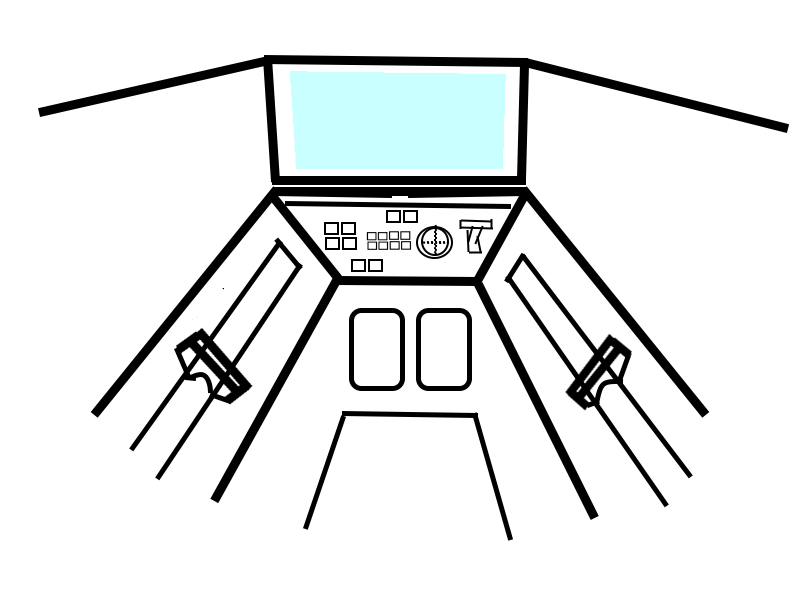
A visual concept for the “cockpit” part of the Chassis component card. Ultimately I didn’t go this direction for visuals but I actually think this design I whipped up is kinda cool.
When it came to designing the controls for Precipice, I knew that a little bit of friction was important. Mechs in Precipice can very in size, agility, and responsiveness, but many of them are lumbering war machines that pulverize terrain beneath their tread. To get you into the fantasy, a little bit of designed-in resistance can go a long way. I knew I wanted to make you feel like the pilot by making several high-level design choices:
Precipice would focus on a single pilot. That pilot can change mechs or even disembark to act on foot, but the spotlight stays on them. That pilot is how you the player primarily interact with the game world, and the limitations of their physical position (inside the mech or on the battlefield) are relevant.
The input system for your actions would include an element of simultaneous hidden choice and sequencing to simulate the experience of managing complex systems.
For mechs to feel like the big, stompy robots they are, movement would be an ongoing state rather than a discrete game action. Mechs would to maintain a degree of momentum after moving, and stopping quickly once at speed would not generally be free.
With that said, when a mech hit an obstruction, the mech would (generally) win and smash on through, or at least damage the obstruction. So even when a bit of resistance causes you to end up in an unexpected place, the consequences are usually less dire than getting stuck on a rock in X-Wing, unable to act or fire.
Crashing into the Fantasy
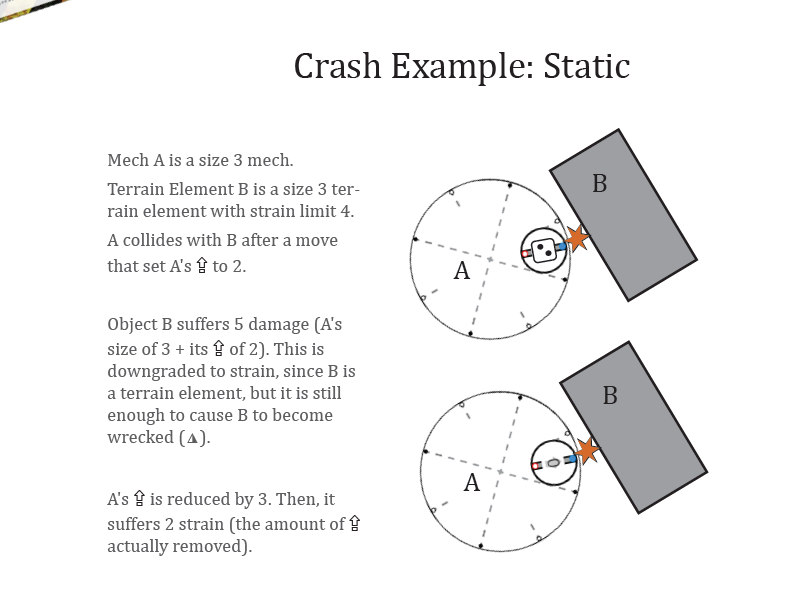
These specific crash rules came later, but I knew that you’d be crashing your mech into stuff at least occasionally.
In addition to the general principles above, I also had a few specific design elements I knew that I wanted to include, such as:
Vector of momentum and facing would be uncoupled, at least for a majority of mechs. X-Wing ships function like World War II fighter planes, but mechs on the ground should feel quite differently. In MechWarrior 3 (and Battletech more broadly), this is handled through torso twisting, but I wanted to be able to cover the more fluid, humanlike movement and facing seen in mecha anime.
Inputs (essentially, your pilot’s use of the mech’s controls) would be planned and resolved sequentially, with all players revealing their next choice simultaneously and then resolving actions in an initiative order based on the input revealed. I knew from my time playing games like Warhammer: Diskwars and Star Wars: Legion tying initiative to the input would create a tense dynamic that felt like a guessing game with the opponent(s), weighing the advantages of acting first or second. Rather than having this control your main strategic action is it does in those games, though, I instead wanted this to be the backbone of the action system, to keep things simple and to encourage multiplayer games by minimizing player downtime.
Everything set up on the battlefield would be to some degree interactable. Small objects could be picked up and thrown, and large structures could be ruined or levelled. This would give you the sense of scale, letting the mechs show the scale of their potency even in encounters where each player controls only one mech. Also, it’s very satisfying to watch your mech smash through a building.
Not only would mech components break down (flipping and being discarded to show damage and destruction), but pilots would have a card that functioned on similar principles, allowing them to be injured or perish separately from the mech. This vulnerability combined with the pilot’s vital importance makes keeping them alive one of your key objectives, tying into the game’s themes of survival in unforgiving environments.
Pilot Skill
Next time, I’ll dig into the design behind the pilot, and how it came to be the center of your experience in Precipice! Until then, if any of this has you excited to check out the game, the Open Alpha Test is available right now. And please consider following the Kickstarter page as we move toward the launch!